
UAE E-Invoicing for Restaurants: What F&B Owners Must Do Before 2027
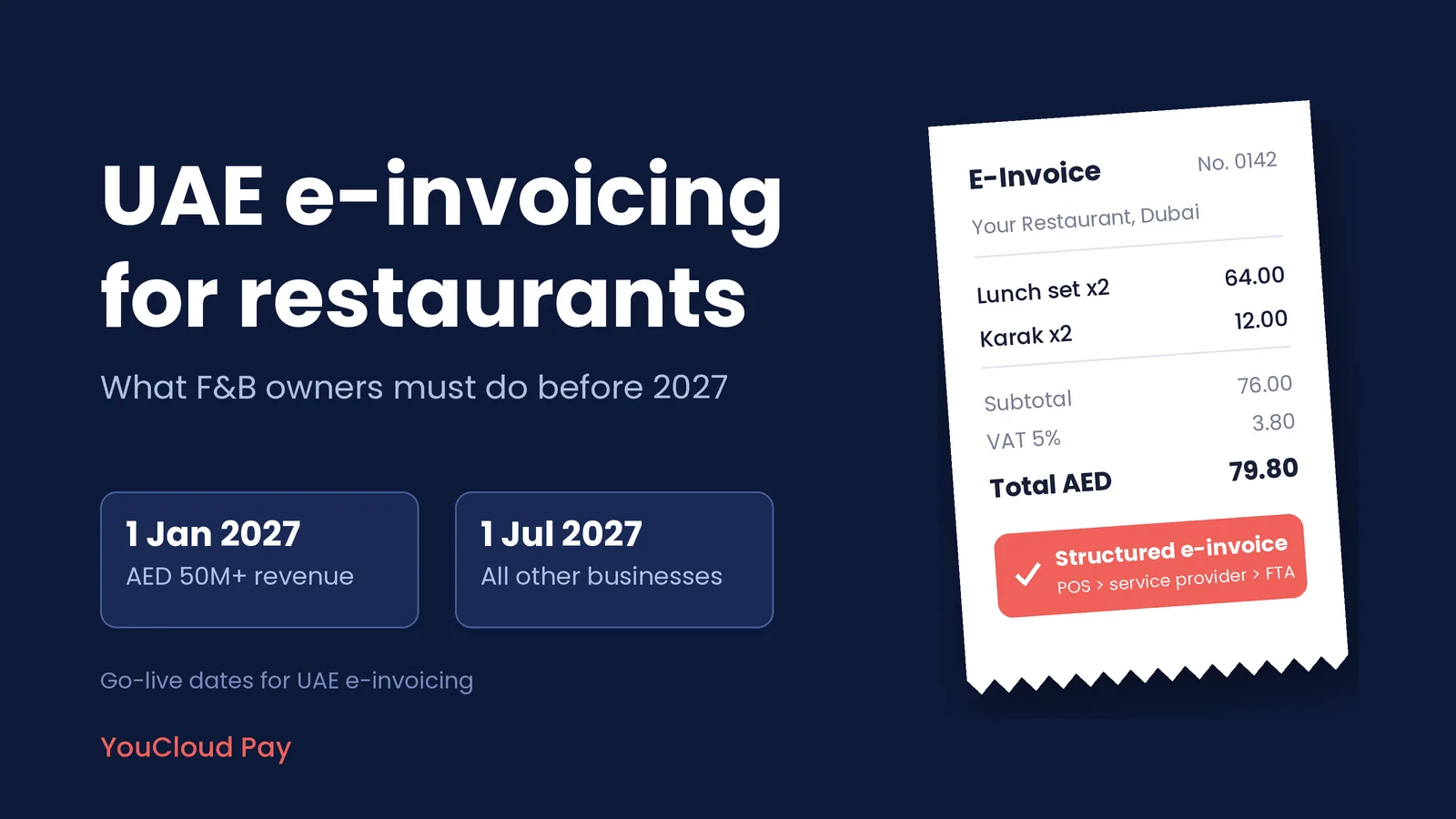
If you run a restaurant, cafe or cloud kitchen in the UAE, UAE e-invoicing for restaurants is about to change how your business issues and receives invoices. The Federal Tax Authority (FTA) is moving the country from paper and PDF invoices to structured digital ones, and the first deadlines arrive within months.
This guide walks through the UAE e-invoicing rollout in plain English. First, you will see the key dates. Next, we cover whether the rules apply to your restaurant and what changes in your billing. Finally, a practical checklist helps you get ready.
Quick note: This article is general information, not tax or legal advice. Please confirm your specific obligations with the FTA or a qualified tax advisor.
What Is E-Invoicing in the UAE?
UAE e-invoicing is not the same as emailing a PDF invoice. Instead, your system creates the invoice as structured data (an XML file) in a standard format. An approved network then checks it automatically, and the tax data reaches the FTA in near real time.
The UAE has adopted the international Peppol standard, which uses a five-corner model. Here is how an invoice travels:
- The seller issues the invoice from their own system, such as a POS or accounting platform.
- Next, the seller's FTA-accredited service provider (ASP) validates it.
- Then the provider passes the invoice to the buyer's ASP.
- After that, the buyer receives it.
- Finally, the tax data goes to the FTA.
The rules for UAE e-invoicing come from Ministerial Decisions 243 and 244 of 2025, and the FTA published a technical document in February 2026 that lists the required data fields. For owners, one point matters most: you cannot send these invoices on your own. Instead, you must appoint an accredited service provider connected to the Peppol network.
UAE E-Invoicing Dates Every Restaurant Owner Should Know
The UAE e-invoicing rollout follows annual revenue, so your deadline depends on your size.
PhaseWhoAppoint a service provider byGo liveVoluntary pilotBusinesses that meet the FTA's technical requirementsn/aFrom 1 July 2026Phase 1Revenue of AED 50 million or more30 October 20261 January 2027Phase 2Revenue below AED 50 million31 March 20271 July 2027GovernmentGovernment entitiesn/a1 October 2027
Most single-outlet restaurants and small cafes will fall into Phase 2 of UAE e-invoicing. However, larger restaurant groups, hospitality companies and multi-brand operators may fall into Phase 1. So check your annual revenue against the threshold, and confirm the latest dates on the FTA website, because timelines can change.
Does UAE E-Invoicing Apply to Your Restaurant?
The first phases cover B2B (business-to-business) and B2G (business-to-government) transactions. For restaurants, that matters more than many owners expect. You are likely affected if you:
- Invoice corporate clients, for example office lunches or monthly accounts
- Run catering or events for companies
- Supply food to hotels, offices, schools or other businesses
- Receive invoices from suppliers, such as food distributors, packaging companies or equipment vendors
That last point is easy to miss. Once your go-live date arrives, you must also receive e-invoices from suppliers through your service provider. So even if most daily sales come from walk-in customers, your purchasing, accounting and VAT workflows will still change.
Everyday sales to individual diners are not part of the first announced phases. Still, rules can evolve, so ask the FTA or your advisor whether your sales mix falls under them.
In addition, everyone needs a Tax Identification Number (TIN) from the FTA to take part in the system.
What UAE E-Invoicing Changes in Your Restaurant's Billing
Four things change in your day-to-day billing.
1. Invoices become structured data. The FTA's technical guidance lists 51 mandatory fields for electronic tax invoices, including invoice number, date, currency, payment terms and tax details. As a result, a simple PDF export from a POS no longer qualifies.
2. Your system must connect to an accredited provider. Your POS or accounting software has to produce data in the required format and pass it to your ASP. Therefore, ask early whether your tools can do this.
3. Reporting happens in near real time. Tax data flows to the FTA as you issue invoices. Because of this, mistakes in VAT rates, customer details or invoice numbering show up sooner.
4. Penalties apply once you enter the mandatory phase. A 2025 Cabinet Decision sets out the penalty framework. However, check the current amounts with the FTA instead of relying on summaries.
Your 7-Step UAE E-Invoicing Readiness Checklist
- Confirm your phase. First, work out your annual revenue and which deadline applies to you, or to each legal entity if you run a group.
- Get your TIN. Next, make sure your business has a Tax Identification Number from the FTA.
- List your invoice types. Then separate walk-in receipts, corporate invoices, catering, supplier bills, credit notes and refunds.
- Audit your current system. After that, ask whether your POS, accounting software and delivery tools can export structured, compliant data.
- Choose an accredited service provider. Also look for an FTA-accredited ASP on the Peppol network, and ask how your POS will connect to it.
- Clean up your master data. Customer names, trade licence and tax numbers, product descriptions and VAT codes need to be complete, because your service provider validates every invoice.
- Test and train. Finally, run test invoices during the pilot period if you can, and train cashiers, managers and your accountant before your go-live date.
Questions to Ask Your POS Provider
Your POS is where most restaurant invoices begin, so it is the first place to check. Start by asking your provider:
- Can your system support UAE e-invoicing and generate invoices in the required format?
- Which accredited service providers do you integrate with?
- How do you handle credit notes, refunds and voided orders?
- Does the system support multiple outlets and legal entities under one group?
- Can you receive supplier e-invoices, or only send them?
- What is your timeline for being ready, and who handles updates when the FTA changes the rules?
If the answers sound vague, treat that as a warning sign. Since deadlines are close, you do not want to switch systems under pressure.
Common UAE E-Invoicing Mistakes Restaurant Owners Make
- Waiting until the deadline. Providers and consultants get busy as dates approach, so start early.
- Assuming the POS vendor handles everything. Your POS may create the invoice, but you still need an accredited service provider and a TIN.
- Ignoring supplier invoices. Receiving e-invoices matters just as much as sending them.
- Overlooking multi-outlet complexity. Therefore, groups with several brands or legal entities should plan each entity separately.
- Treating it as an IT issue only. Finance, operations and the owner all need to take part, so involve them early.
Frequently Asked Questions
Is UAE e-invoicing mandatory for restaurants?
Yes, in phases. Businesses with revenue of AED 50 million or more go live from 1 January 2027, while smaller businesses follow from 1 July 2027. Because the first phases focus on B2B and B2G transactions, restaurants with corporate clients, catering or supplier invoices feel it most.
Do I need to be VAT-registered?
You need a Tax Identification Number from the FTA to take part. However, confirm with the FTA or your advisor how your VAT status affects your obligations.
Can my POS send e-invoices directly to the FTA?
No. Invoices travel through accredited service providers on the Peppol network, and those providers also report tax data to the FTA. For this reason, your POS needs to connect to one of them.
Will a PDF invoice still work?
However, for in-scope transactions, a PDF alone will not meet the requirement. Instead, the invoice must be structured data in the approved format.
Can I start before the deadline?
Yes. A voluntary pilot opened on 1 July 2026 for businesses that meet the FTA's technical requirements. In fact, starting early gives you time to find and fix problems.
What should I do first?
Start by confirming your phase and checking that you have a TIN. Then ask your POS and accounting providers how they will support e-invoicing.
Get Your Restaurant Ready for UAE E-Invoicing
UAE e-invoicing will reward restaurants that prepare early. So start with your billing flow, your data, and a conversation with your POS provider.
At YouCloud Pay, we build POS, inventory and payment solutions for restaurants, cafes and retailers in the UAE. If you want to review how your current setup handles invoicing, or compare options before your go-live date, get in touch with our team for a free walkthrough.
Dates and requirements in this article reflect public information available in October 2026 and may change. Always verify with the Federal Tax Authority.